The Last Two Weeks of Summer Break: A Family Movement Plan That Fights the Boredom
Quick Answer: The last two weeks of break fail because the structure is gone - camps ended, novelty wore off, and parents are back at work. The fix is a light daily skeleton, not a packed schedule: one morning outdoor hour before the heat, one water-adjacent afternoon activity, one family evening walk or game after dinner. Add a two-week challenge grid the kids help design, and shift wake times ten minutes earlier every couple of days so the first school morning is not a cliff. Boredom plus a tiny structure becomes invention; boredom alone becomes screens.
Every family knows this exact stretch: the sports and camps have wrapped, the vacation already happened, and school sits ten days away like a slow-approaching planet. The kids are bored of the pool, bored of the yard, bored of each other. This is not a parenting failure. It is a structure vacuum - and it takes surprisingly little structure to fill it.

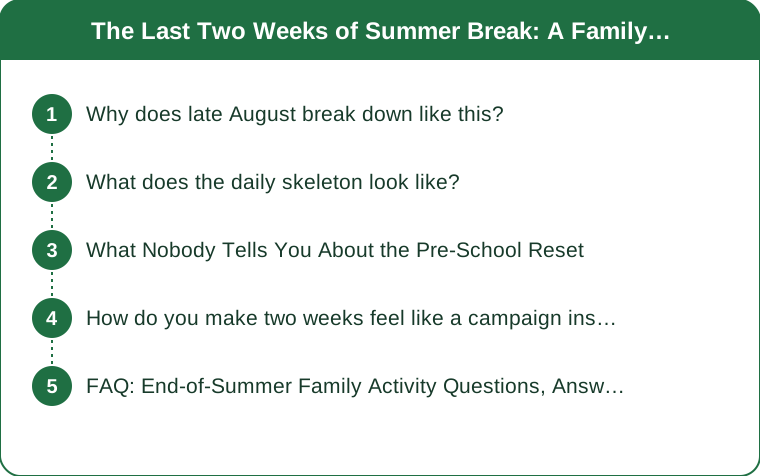
Why does late August break down like this?
Four forces hit at once, and naming them makes the plan obvious.
The scaffolding is gone. June and July run on structure someone else built - camps, swim lessons, leagues, trips. Almost all of it ends by mid-August because the programming world assumes school is starting, even in districts where it has not. The kids did not get less capable of activity; the container for it evaporated.
Novelty is fully depleted. The pool that was magic in June is furniture by now. The eleventh visit to the same playground offers nothing new to an eight-year-old brain that has mapped every inch. Familiar options read as no options, which is why what do you want to do gets answered with nothing.
Parents are at maximum depletion too. By late August the adults have been running summer logistics for ten weeks, often while working. The energy to be the daily activities director is gone precisely when the need for one peaks. Any plan that requires a fresh, enthusiastic parent daily is dead on arrival - the plan has to run on low parental fuel.
And the heat compresses the day. Late August afternoons in most of the country are the year’s most hostile outdoor hours, which squeezes activity into a morning window and an evening window. Families that do not deliberately use those windows end up with zero outdoor time by accident, then wonder why everyone is climbing the walls at 4pm.
The reframe that helps: you do not need to replace camp. Camp was seven structured hours; the actual need is two or three anchored ones. The rest of the day can be gloriously unscheduled once the anchors exist - unstructured time stops curdling into misery when it has edges.
What does the daily skeleton look like?
Three anchors, none requiring an energetic adult.
Anchor 1: the morning hour, before 10am. Out the door before the heat arrives, and before the day loses its shape. The content barely matters - bikes, the good far-away playground, a creek walk, chalk obstacle courses in the driveway - what matters is that it happens first, while the air is under 80 and everyone still has their morning agreeableness. Working parents: this can be a backyard hour with a checklist while you take a call. It counts.
Anchor 2: the water-adjacent afternoon. Water is the only thing that beats late-August heat, and it does not require a pool pass daily. Sprinkler in the yard, water balloon restocks, washing the car slowly and badly, a kiddie-pool refresh for the youngest, ice-block excavations - freeze small toys in a container of water and hand over spoons. The 1pm-to-4pm furnace hours have exactly one job: be wet or be inside, and either is fine.
Anchor 3: the family evening loop, after dinner. The whole household, out the door, same route most nights. Twenty to thirty minutes. By late August this hour has turned gentle again - it is the best outdoor slot of the day and the easiest one to attend, because everyone is home and dinner needs walking off. This anchor is the one worth protecting hardest: it costs nothing, it is where the actual conversations happen, and it survives into the school year as the family’s default movement habit. Dress code: whatever is on - this is a flip-flops-and-leggings stroll, not a workout requiring a costume change.
Everything between the anchors stays unscheduled on purpose. The skeleton is not a camp replacement schedule; it is three fixed points that keep the day from dissolving. Bored gaps between anchors are where kids invent things - the anchors just keep the gaps from being the whole day.

What Nobody Tells You About the Pre-School Reset
The sleep shift needs ten days, and it is a movement issue. Summer bedtimes drift 60 to 90 minutes late, and the first school week collides with that drift hard. Shifting wake time 10 to 15 minutes earlier every second day starting now makes the transition invisible - and the secret lever is the morning anchor, because early outdoor light is the strongest bedtime-shifting tool there is. The morning hour is quietly doing double duty.
Kids need a decompression period, not a grand finale. The instinct is to cram the last week with capstone outings. But kids process transitions through boring, safe, repetitive days - the emotional prep for a new school year happens during the eleventh evening walk, not at the amusement park. One special outing is lovely; five is a stressed family spending money to be tired.
Screens are filling a vacuum, not corrupting anyone. Late-August screen creep is the natural result of a structure vacuum, and fighting it with rules alone turns the house adversarial. The anchors compete better than the rules do: screens before the morning anchor is the only boundary that pulls real weight, because a day that starts outside bends differently than a day that starts on a couch.
Back-to-school nerves burn energy invisibly. A kid who is quietly anxious about a new teacher or a friend-group reshuffle gets tired, clingy, and irritable in ways that look like too much summer. Movement is legitimately the best-evidenced tool the family already has - anxious energy metabolizes on a bike far better than on a sofa - and side-by-side activity is where kids actually mention the thing they are nervous about.
And your participation is the multiplier. A parent on a bench produces a different afternoon than a parent in the sprinkler for even five minutes. Dress for joining, not supervising - the yoga pants rule: if you left the house able to run, you will end up running, and the kids clock the difference instantly.
How do you make two weeks feel like a campaign instead of a countdown?
Give it a shape, a scoreboard, and an ending.
Build the two-week challenge grid together. One evening, one piece of paper, fourteen boxes. Fill them as a family with small physical dares: bike a route we have never ridden, everyone holds a plank during one commercial, walk to the far ice-cream place, 500 jumps on the trampoline counted out loud, find the steepest hill in the neighborhood and run it once. The kids’ terrible suggestions are the best ones - a challenge they authored has triple the compliance of one you assigned. Crossing boxes off is the game; there is no prize needed beyond the crossing-off.
Score steps or minutes only if your crew likes numbers. Some families light up over a shared step goal - a walk to the moon chart on the fridge where every family member’s daily steps add miles. Others find tracking turns play into homework. Know your audience; the grid works without any numbers at all.
Plan exactly one finale. The last Saturday before school: the biggest hike, the far beach, the water park - one event that closes the season on purpose. An ending you chose beats an ending that just happens to you, and it gives the final week a landmark to aim at.
Then keep the survivor. When school starts, the morning anchor and the challenge grid retire - but the evening walk does not have to. Families that carry the after-dinner loop into September keep a daily movement habit and a daily conversation habit straight through the school year, which turns out to be the most valuable thing the dead weeks built.
A realistic note on the plan failing: it will, on some days - a work crisis, a rained-out morning, a kid who refuses everything. A skeleton with two of three anchors hit is a completely successful day. The bar is not perfect; the bar is shaped days instead of shapeless ones, ten times out of fourteen.
FAQ: End-of-Summer Family Activity Questions, Answered
How do I keep kids active the last weeks of summer break?
Build a three-anchor day instead of a full schedule: an outdoor hour before 10am, a water-based activity in the hot early afternoon, and a family walk or game after dinner. Add a fourteen-box challenge grid the kids help write. Light structure turns boredom into invention; no structure turns it into screens.
When should we start adjusting sleep for the school year?
About ten days out - which in most districts means now. Shift wake times 10 to 15 minutes earlier every second day, and use morning outdoor light to make the shift stick, since early light is the strongest natural bedtime-mover. The morning activity anchor and the sleep reset are the same project.
What are good active ideas when kids are bored of everything?
Change the frame, not the equipment: familiar things made novel beat new things. A bike route chosen by coin flips at every corner, a playground you have never driven to, an obstacle course they design and you attempt, ice-block toy excavations, a hill worth racing. Authorship is the novelty - whatever they invent, they will do.
How much activity do kids actually need daily?
The general guideline is about 60 minutes of moderate-to-vigorous movement a day for school-age kids, and it accumulates in pieces - three anchors comfortably cover it without anyone counting. Watch mood and sleep rather than minutes: a kid who is sleeping well and reasonably pleasant by evening is getting enough.
TL;DR:
- The late-August collapse is a structure vacuum, not a parenting failure - camps ended and the container vanished.
- Three anchors fix it: morning hour before the heat, wet afternoons, family evening walk.
- Start the sleep shift now - ten days, fifteen minutes at a time, powered by morning light.
- A kid-authored fourteen-box challenge grid beats any schedule an adult assigns.
- Keep one thing in September: the after-dinner family loop is the habit worth smuggling into the school year.
The deadest stretch of summer is ten shapeless days waiting for three anchors. Give it edges and it gives you back the best two weeks of the break.
See It in Motion
Seen here: High Waist Yoga Leggings with Side Pockets — shop it on bubblelime.com
Keep Reading
This article is for general informational and styling purposes only. Fit, sizing, and product availability may vary.