Family Movement When the Only Free Slot Is Before School
Quick Answer: Before-school movement works only if it is short, non-negotiable in placement, and attached to something that already happens. Fifteen minutes is the realistic ceiling and eight is enough. The three formats that survive contact with a school morning are the walk that replaces part of the journey, the two-minute burst between two fixed points in the routine (after teeth, before shoes), and movement that runs alongside an existing task rather than competing with it. What fails, reliably, is anything requiring a decision, a change of clothes, or enthusiasm.
After-school is football on Tuesday, homework on Wednesday, and a pick-up that runs late on Thursday. The evening is gone.
So the morning is what is left, which is unfortunate, because a school morning is the least flexible fifteen minutes in the week and children are at their least cooperative in it.
It can still work. It just has to be built completely differently from an evening session.

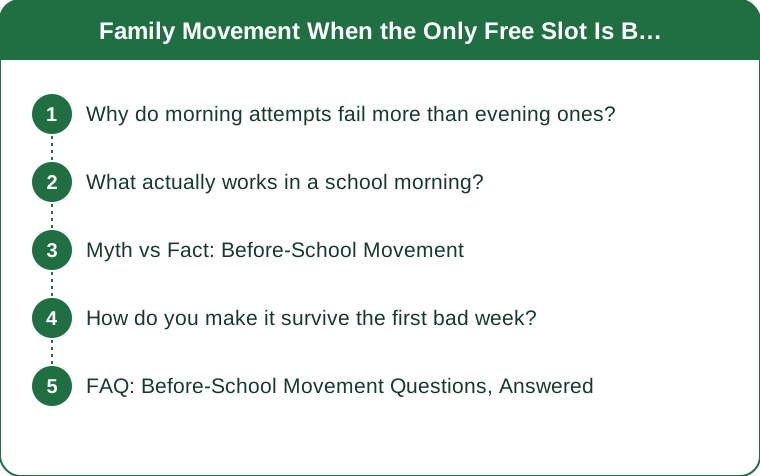
Why do morning attempts fail more than evening ones?
Because a school morning is a fixed-length container with a hard deadline, and anything added to it displaces something else.
Evening movement can expand and contract. If it runs ten minutes long, dinner is ten minutes later. A morning that runs ten minutes long means missing the bus, which is a real consequence, and everyone in the house knows it.
That produces the specific failure pattern: the movement gets dropped first, every time there is any friction, because it is the only item in the morning with no external enforcement.
There are three other things working against you:
Children are physiologically slow to start. Sleep inertia is more pronounced in children and adolescents, and teenagers in particular have a genuinely shifted body clock. Asking a 14-year-old to be enthusiastic about movement at 7:15am is asking for something their biology is actively resisting.
The morning is already decision-dense. What to wear, what to eat, where the reading folder is. Adding a decision - what shall we do today? - to a morning that is already at capacity is why so many well-designed plans last four days.
Nobody wants to change clothes twice. Anything requiring a kit change is dead on arrival. This single constraint eliminates most of what people first try.
And a fourth that is arriving right now: it is getting darker. The morning that worked in June is a different proposition in late September, and outdoor before-school movement has a shelf life that people do not plan for.
What actually works in a school morning?
Three formats, all of which avoid decisions and kit changes.
1. Convert part of the journey. By some distance the most durable option. Park five minutes further away. Get off a stop early. Walk the last section. It requires no additional time beyond the walking itself, no change of clothes, no negotiation, and it happens automatically because the journey has to happen anyway.
The reason this works where other things fail is that it is not an extra item. It is a modification of an existing one, so there is nothing to skip.
2. The two-minute burst between two fixed points. Pick two things that already happen in a fixed order - after teeth and before shoes, or while toast is in the toaster. Put a very short movement in the gap. Ten squats, a plank hold, twenty star jumps, a race up the stairs twice.
Two minutes is the right length, not a compromise. It is short enough that nobody argues, short enough that it does not threaten the deadline, and long enough to be worth doing. The anchor points are what make it stick - it is not a decision, it is a step in a sequence.
3. Movement layered onto an existing task. Calf raises while brushing teeth. Carrying bags to the car in two trips instead of one. Standing on one leg while waiting for the kettle. Small, unglamorous, and it accumulates.
What consistently fails: anything with a warm-up, anything needing equipment retrieved from somewhere, anything requiring the parent to lead a session, and anything that depends on the children wanting to do it on a given day.

Myth vs Fact: Before-School Movement
Myth: It needs to be at least twenty minutes to count. Fact: For children, the guidance is about total daily activity across all sources, and short bouts contribute fully. Two minutes before school plus a longer walk plus playtime is a legitimate way to accumulate it. The twenty-minute-block idea comes from adult training frameworks and does not apply well here.
Myth: The children need to enjoy it or it will not last. Fact: Durability comes from placement, not enthusiasm. Nobody enjoys brushing their teeth either - it survives because it is in a fixed slot in a sequence. Enjoyment helps and it is not the load-bearing element.
Myth: You should let teenagers sleep instead. Fact: Genuinely a fair point, and sleep should win over an added morning session. But converting part of the journey to a walk does not cost any sleep, which is exactly why it is the format that works for teenagers when nothing else does.
Myth: If it does not happen every day it is not working. Fact: Three or four mornings out of five is a good outcome for anything embedded in a school routine. Aiming for five and treating four as failure is how people abandon systems that were working.
Myth: Morning exercise will make them tired at school. Fact: The opposite, for anything at this intensity. Light-to-moderate morning movement is associated with better attention and behaviour in the school day. The intensity involved in a two-minute burst or a ten-minute walk is nowhere near enough to cause fatigue.
Myth: You have to do it with them. Fact: Doing it alongside them helps enormously, because children copy what parents do far more reliably than what parents ask for. But a walk to school that they do with a friend or a sibling is not less valuable because you were not there.
How do you make it survive the first bad week?
Assume it will be tested in week two, and build for that in week one.
Anchor it to something that cannot be skipped. Teeth, shoes, the front door. The anchor is what carries the habit through the mornings when nobody is interested.
Decide it once, in advance, and never again. The same movement every day for the first fortnight. Variety is the enemy in a school morning because variety means a decision, and a decision at 7:20 means it does not happen.
Move the trigger, not the willpower, when it fails. If it keeps getting missed after breakfast, try before breakfast. Three attempts at different placements will usually find one that works, and that is a better use of effort than trying harder in the same slot.
Keep the bar embarrassingly low on bad days. One set of ten. Walking to the end of the road. The habit is the point; the volume can vary enormously without breaking anything.
Set out what is needed the night before. Shoes by the door, coats down, bags packed. Every minute recovered from the morning’s chaos is a minute the movement can use, and this is where it comes from.
Let the youngest lead it. A five-year-old choosing today’s movement from a list of three will produce far more compliance from the whole household than a parent announcing it. Three options is the right number - enough agency, not enough to be a discussion.
And plan for the dark now. The outdoor version of this stops working somewhere in October in most places. Deciding in advance what the indoor version is - the two-minute stair burst, the hallway shuttle - means the habit transfers rather than ending when the clocks change. The families whose morning movement survives the winter are the ones who chose the indoor version in September, before they needed it.
FAQ: Before-School Movement Questions, Answered
How long does it actually need to be?
Eight to fifteen minutes is the realistic and useful range for a school morning, and two minutes of something is meaningfully better than nothing. Children’s activity guidance is based on daily totals accumulated across the whole day, so the before-school portion is a contribution rather than a complete session. Consistency at two minutes beats an ambitious twenty that happens twice.
What if one child refuses and the other is keen?
Run it as an open invitation rather than a requirement, and let the keen one participate visibly. Refusal is usually about autonomy rather than about the activity, and a movement that happens whether or not everyone joins is much more likely to pull in the reluctant one over a few weeks than a movement that stops for negotiation. Do not make it a rule that has to be enforced - that converts it into a battle you will lose on a wet Tuesday.
Is it worth it if it is only ten minutes of walking?
Yes. Ten minutes of walking each way is twenty minutes of daily activity, five days a week, that requires no extra time and no equipment. Over a school year that is a very substantial total, and it comes with better arrival-at-school alertness and a bit of daylight exposure, which matters more as the mornings get darker.
TL;DR:
- School mornings are a fixed container with a hard deadline - anything added gets dropped first unless it is attached to something existing.
- Three formats survive: converting part of the journey, a two-minute burst between two fixed points, and movement layered onto an existing task.
- Kit changes, equipment, warm-ups and daily decisions all kill it.
- Same movement every day for the first fortnight. Variety is a decision, and decisions do not survive 7:20am.
- Choose the indoor version in September, before the dark mornings arrive and the outdoor one stops working.
The morning slot is not worse than the evening one. It just has to be two minutes long and bolted to something that already happens.
Keep Reading
This article is for general informational and styling purposes only. Fit, sizing, and product availability may vary.