When Family Fitness Becomes One More Thing the Parent Manages
Quick Answer: Family fitness collapses onto one parent because it is usually structured as an event that requires organizing rather than a habit attached to something already happening. The fix is to reduce the number of decisions to zero — one fixed slot, one default activity, kids given real ownership of one element — and to protect one session a week that is yours alone and not family-anything.
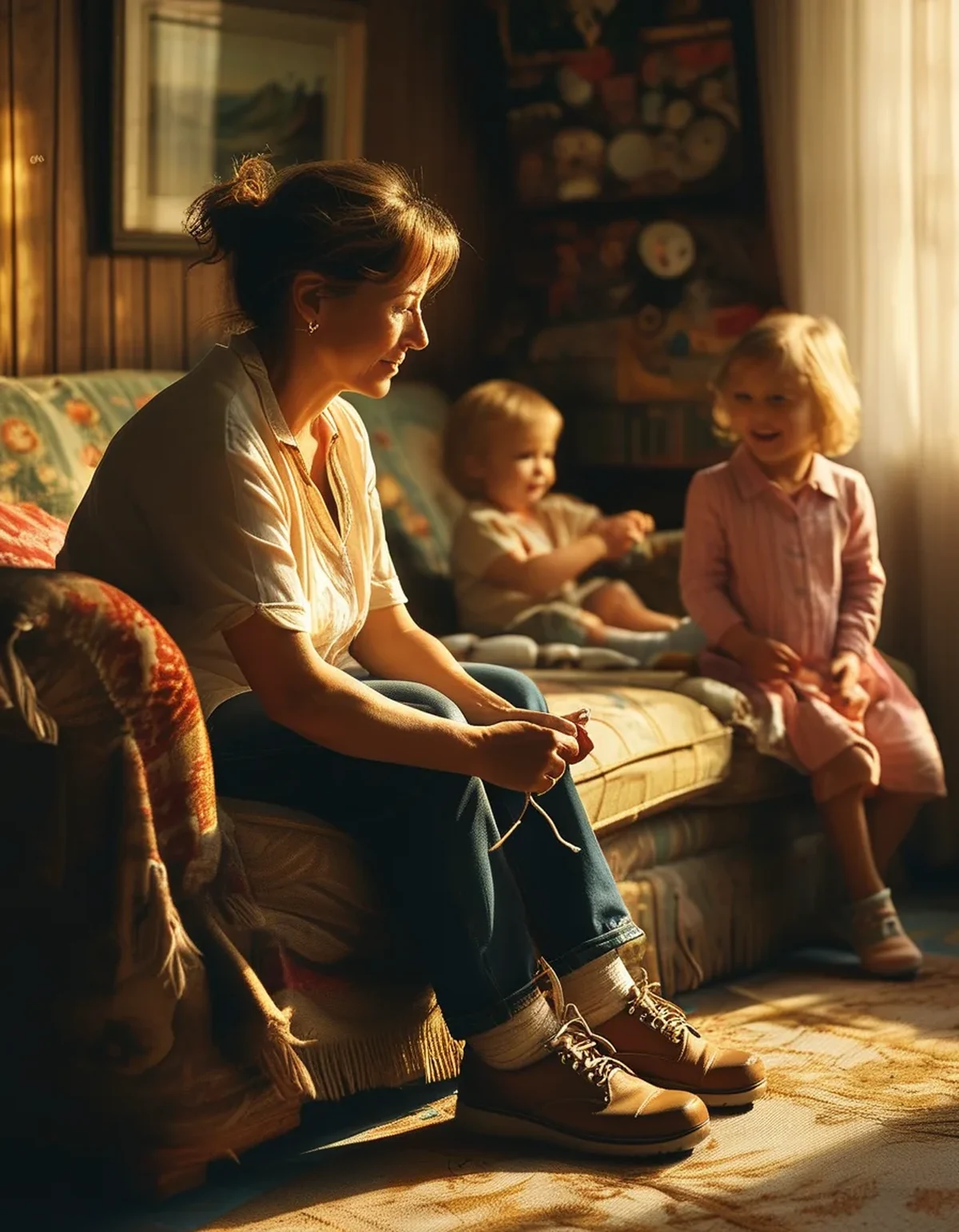
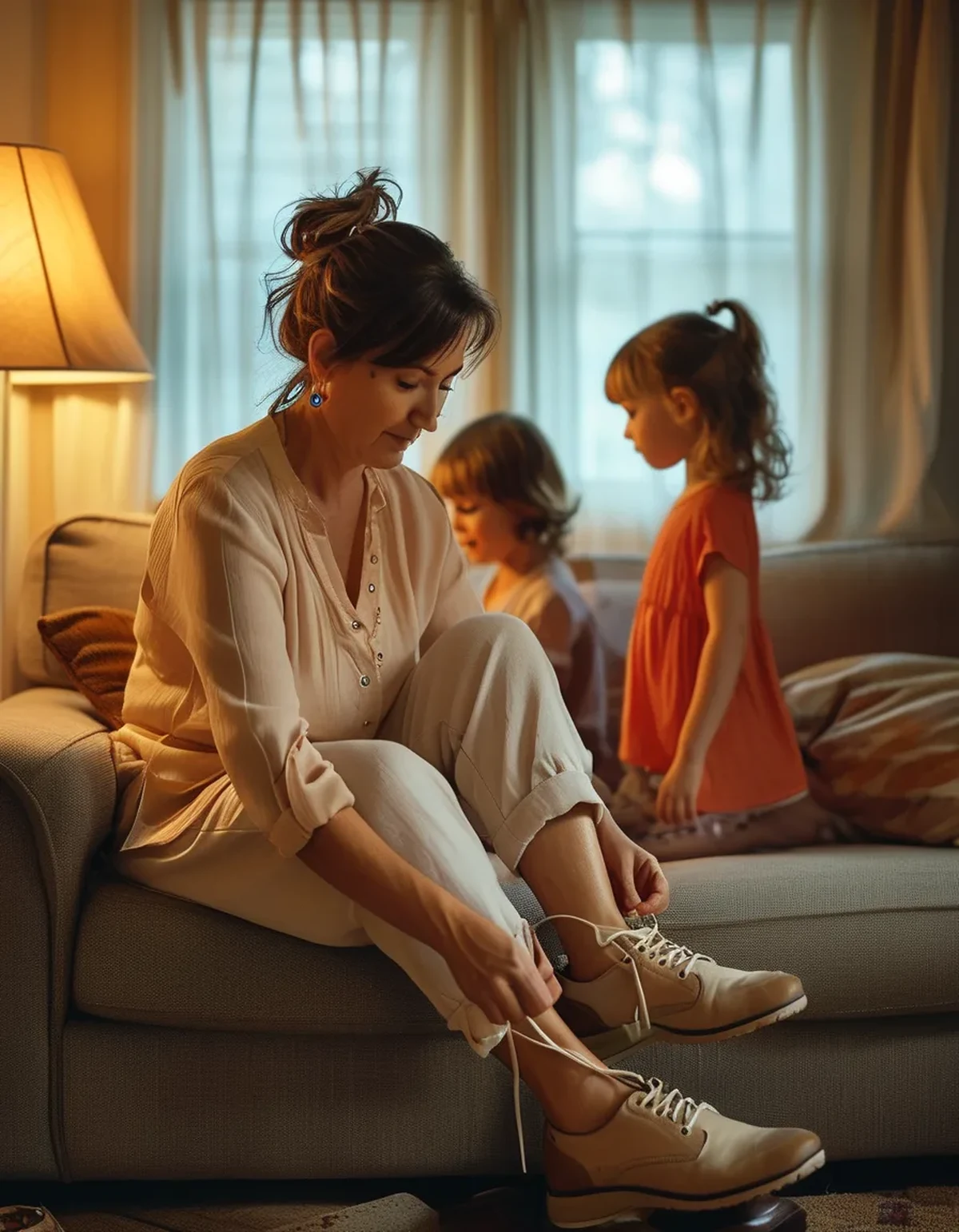
You are the one who checks the weather, who finds everyone’s shoes, who talks the reluctant one into it, who breaks up the argument on the walk, and who gets home having supervised forty-five minutes of activity without doing any of it.
You are not doing family fitness. You are running a small event, three times a week, unpaid, and it is the reason you have stopped doing your own.
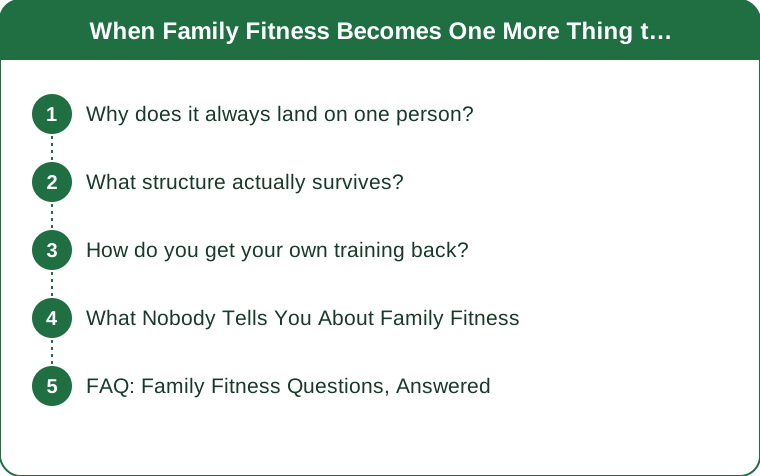
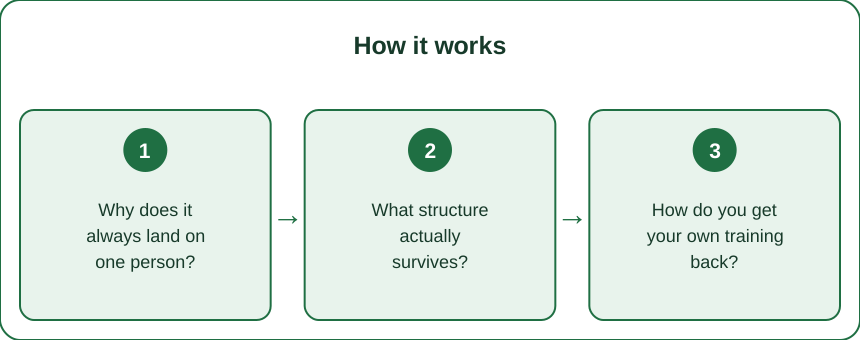
Why does it always land on one person?
Because family activity has an invisible layer that nobody assigns.
Every family walk requires a chain of decisions before it happens: is today the day, is the weather workable, who is coming, what needs packing, does it clash with homework, who talks the reluctant one round. This is planning work, and the person who does it is doing a job that is not visible in the activity itself and does not get counted as effort by anyone, including often the person doing it.
Two specific things make family exercise worse than other family logistics.
First, it is discretionary. Dinner has to happen; the walk does not. Discretionary tasks are the ones that require someone to actively champion them, and championing is exhausting in a way that executing is not.
Second, the outcome is contingent on other people’s mood. A parent can control whether dinner arrives on the table. Nobody can control whether an eleven-year-old will be enthusiastic today. Doing organizing work whose success depends on someone else’s willingness is a specific and reliably depleting kind of labor.
The result is the pattern almost every family reports: it works brilliantly for two weeks while it is novel, then decays into one person nagging, then stops — and the person who was running it concludes their family is not the sporty type. What actually failed was a structure that required constant human effort to stay upright.
What structure actually survives?
Anything that removes the decisions. Three principles do most of the work.
One fixed slot, always the same. Not three flexible ones. Saturday morning, or after dinner on Tuesday and Thursday — the specific slot matters far less than the fact that it never moves. A fixed slot cannot be negotiated with, which removes the single largest source of the parent’s labor: the daily conversation about whether it is happening.
One default activity that needs no planning. The same loop, the same park, the same route. Novelty is the enemy here, despite every article recommending it. A default means nobody has to decide, nobody has to look anything up, and the shoes live by the door. Add variation later, once the habit is load-bearing.
Real ownership handed to a kid. Not fake choices between two things you already selected — an actual job with a real consequence: one child picks the route, another times it, another is responsible for the water bottles. Children who have a job in an activity resist it dramatically less than children who are being taken on it, and the job removes work from you at the same time.
And the one that changes it most: stop being the entertainment. The failure mode is a parent who spends the whole time managing engagement — encouraging, refereeing, keeping it fun. Walk your walk. Let them be bored for a bit. Boredom on a walk resolves itself in about four minutes and the resolution is usually them talking to you, which was the point.
How do you get your own training back?
By accepting that family activity is not your workout, and building around that honestly.
This is the part most advice avoids, because it sounds selfish. It is not — it is a structural observation. A session where you are supervising, pacing to the slowest person, and stopping every four minutes is a good thing for the family and it is not training. If your entire physical activity is family activity, your own fitness has quietly become a casualty, and that shows up eventually as resentment aimed at the family walk.
Protect one session a week that is not family anything. One. Not five. A single non-negotiable ninety minutes with your name on it is achievable in almost every household and it is the difference between sustaining this for years and burning out by November.
Trade explicitly rather than hoping. The most reliable arrangement in two-parent households is a straight swap: you take Saturday morning, they take Sunday morning, both are protected, neither has to be justified each week. In single-parent households, the equivalent is a swap with another parent — you take both sets of kids for ninety minutes, they take both the following week.
Stack your own training onto the family slot where the geography allows. Kid at practice: you walk or run for the duration rather than sitting in the car. Playground: you do a circuit on the perimeter. This is not ideal and it is real training, and over a school year it adds up to more than the ideal version you never manage.
Say out loud that it matters. Kids model the relationship with exercise, not the activity. A parent who visibly protects their own training is teaching something that no amount of organized family activity teaches.
What Nobody Tells You About Family Fitness
Week three is when it dies, and it is predictable. The novelty carries the first two weeks. Week three is the first week where it has to run on structure alone, and if the structure is you, week three is when you find out. Plan for week three specifically — that is the week to lower the bar rather than push.
The reluctant child is usually reluctant about something other than the activity. Being bad at it in front of a sibling, the walk being boring without a friend, the transition from a screen. The stated objection is almost never the actual one, and asking the actual question — what would make this not terrible — gets an answer more often than persuading does.
Kids do not need it to be fun. They need it to be predictable. The relentless push to make family exercise fun is exhausting for parents and largely unnecessary. Something that simply always happens on Saturday gets far less resistance than something that has to justify itself each time by being enjoyable.
Your teenager will come back. The withdrawal from family activity around thirteen is developmentally normal and not a verdict on what you built. Families who keep the slot running without forcing attendance frequently find the teenager rejoins at sixteen, on their own terms. Families who dissolve it have nothing to rejoin.
The school year is the opportunity, not the obstacle. Term time has a rigid structure you can attach to. Summer has none, which is exactly why summer plans fall apart and September restarts work.
FAQ: Family Fitness Questions, Answered
How much should we actually be doing?
The general guidance for children and teens is around an hour a day of moderate to vigorous activity, but almost all of it comes from play, walking, and school, not from organized family sessions. Two or three family slots a week is a good target and does not need to carry the whole hour.
What if my kids are very different ages?
Give them different jobs in the same activity rather than trying to find something that suits both. The nine-year-old sets the route, the four-year-old is on the scooter, the teenager is allowed headphones. Same walk, three different experiences, one parent.
My partner is not interested. Is it worth continuing alone?
Yes, and it is worth stopping trying to recruit them, because that recruitment effort is often more depleting than the activity. What kids take from it is one parent for whom this is normal, and that works fine as a sample size of one.
Everything falls apart once the evenings get dark. Any fix?
Move the slot before the clocks do, not after. A family habit that is already established at four in the afternoon on a Saturday survives the seasonal change. One that lives at six on a weekday evening will not, and late August is exactly the moment to make that move.
TL;DR:
- Family fitness lands on one parent because of the invisible planning layer, not the activity itself.
- Fixed slot, default activity, no weekly negotiation — decisions are what exhaust you, not the walking.
- Give each kid a real job; ownership reduces resistance and removes work from you at the same time.
- Family activity is not your training. Protect one session a week that belongs only to you.
- Plan for week three, when the novelty runs out and the structure has to hold on its own.
If you change one thing this week: pick the slot, tell everyone it is now permanent, and stop asking whether it is happening. The nagging was never the activity — it was the negotiation, and you can just delete it.
Keep Reading
This article is for general informational and styling purposes only. Fit, sizing, and product availability may vary.