The First Two Weeks of the School Year Will Break Your Family Fitness Routine
Quick Answer: Summer family activity runs on unstructured time, which disappears the week school starts. The routine does not fail because anyone lost motivation — it fails because its enabling condition vanished and nothing was designed to replace it. Fix it by choosing one anchored slot that fits the new schedule, starting it in week one before the calendar fills, and keeping it deliberately small.
By late September every year, the family that was outside every evening in July is doing nothing.
Nobody decided that. It just happened, and it happens the same way every time.

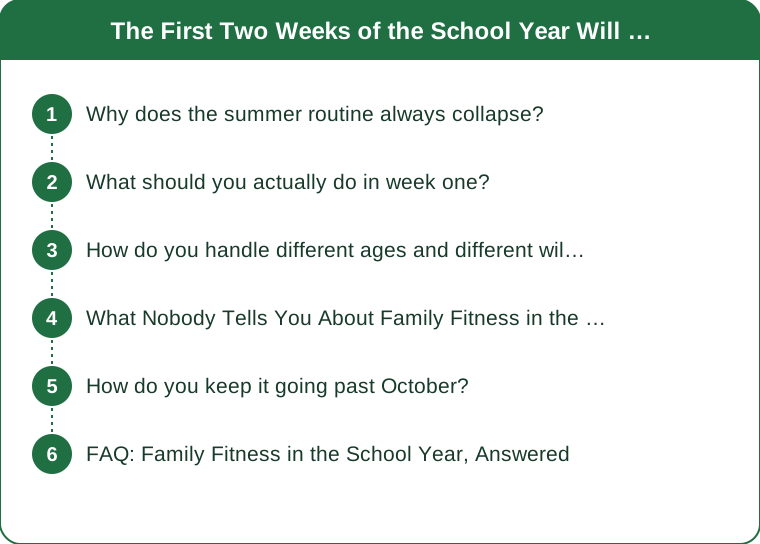
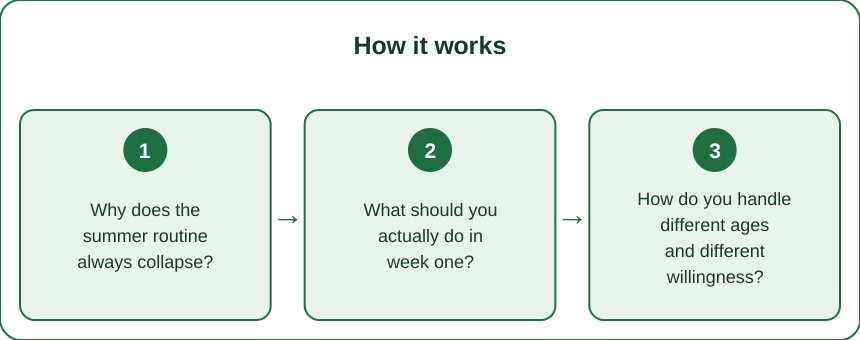
Why does the summer routine always collapse?
Because it was built on conditions that end abruptly.
Summer family activity depends on unstructured time and long evenings. No homework, flexible bedtimes, light until 8:30, and no competing commitments. Under those conditions, activity happens spontaneously — you go outside because there is nothing stopping you.
Every one of those conditions disappears in the first two weeks of September:
- Homework arrives, and it consumes exactly the after-school window.
- Daylight is shrinking fast. Late August into late September loses a substantial amount of evening light, and it accelerates through October.
- Activities and sports schedules start, filling evenings with commitments that are not family activity.
- Everyone is more tired, because the school-year schedule is more demanding than summer for children and parents both.
- Morning routines get tighter, removing the other flexible window.
The critical insight: nothing failed. The routine did not depend on motivation, so motivation is not what to fix. It depended on available time, and the available time is gone.
That matters because the usual response — trying harder, feeling guilty, or making an ambitious new plan — targets the wrong thing. The actual task is to design a routine that fits the new constraints, which are entirely predictable and are already visible.
What should you actually do in week one?
Act early, and go smaller than feels right.
Start in the first week of school, before the calendar fills. This is the single most important piece of timing. By week three, sports schedules, homework patterns, and evening commitments have solidified, and inserting anything new means displacing something. In week one, the slot is still available.
Choose exactly one anchored slot. Not three options, not a flexible plan. One specific time, tied to something that already happens every day.
Slots that survive the school year:
- Immediately after school, before homework. Twenty minutes outside before settling in. Works well because children need decompression at that point anyway, and it uses the daylight that is disappearing.
- After dinner, before screens. A short walk. Effective because it is anchored to a fixed daily event.
- Weekend morning. One longer activity, protected as a family commitment rather than a nice idea.
Slots that do not survive: anything before school, anything requiring travel on a weeknight, and anything scheduled for “when we have time.”
Keep it deliberately small. Twenty minutes, three times a week is a routine that survives October. An hour daily is a routine that lasts nine days. The instinct to start ambitious is the most common way this fails, and it fails in a specific pattern: strong week one, partial week two, gone by week four.
Write it on the family calendar in the same way as any other commitment. Unwritten intentions lose to written ones, every time.
How do you handle different ages and different willingness?
The two hardest problems, and they have different answers.
Different ages in the same activity:
- Walking works across almost every age range and is why it is the most durable family activity. Younger children can scooter or bike alongside while older ones walk.
- Give older children a role rather than an instruction — navigator, timer, choosing the route. Autonomy is what keeps older children participating.
- Accept parallel activity as success. Everyone outside doing different things in the same place is a win, and it beats a forced shared activity that half the family resents.
- Pick activities with adjustable intensity — a bike ride where some go further, a park where some run and some walk.
Different willingness — the teenager problem:
- Reduce the ask. Fifteen minutes is negotiable in a way that an hour is not.
- Let them choose the activity, even if it is not what you would pick. Participation in something they chose beats resistance to something you chose.
- Do not make it about fitness. Framing it as health or exercise is reliably counterproductive with teenagers. Frame it as time, or as walking the dog, or as getting out of the house.
- Bring a friend into it if that is possible. It changes the social calculation entirely.
- Accept partial participation. A teenager who comes half the time is participating.
One thing that matters more than any technique: children are far more influenced by what parents actually do than by what parents ask them to do. A parent who exercises consistently and does not lecture about it tends to produce more active children than one who does the reverse. If the routine is genuinely for the whole family, that is the strongest version of it.

What Nobody Tells You About Family Fitness in the School Year
The after-school window closes faster than any other. In week one it is empty. By week four it holds homework, activities, and screen time. Whatever you want in that slot needs to be there first.
Daylight is the constraint nobody plans for. The evening activity that works beautifully in early September is happening in the dark by mid-October. Decide now what the dark-evening version is — an indoor activity, a lit route, or moving to a weekend slot — rather than discovering the problem when it arrives.
Organized sports do not replace family activity. A child on a soccer team is getting exercise and is not getting family time or the habit of choosing to be active. They are different things with different value, and one does not substitute for the other.
Everyone is more tired in the first three weeks of school than they will be later. This is a real transition cost, for children and parents. Plan the routine for the tired version of your family, not the energetic one, or it will be abandoned during exactly the period you are trying to establish it.
The walk to and from school is the highest-leverage family activity available if it is at all feasible. It is already anchored, already daily, and requires no additional time. Even parking a few blocks away converts an existing trip into activity.
Weekend activity is easier to protect than weekday activity and is worth prioritizing if weekdays are genuinely full. One protected weekend morning beats five unprotected weekday intentions.
Consistency beats intensity by a wide margin at every age. Twenty minutes of walking most days does more for a family’s long-term activity habits than an ambitious weekend program that happens twice.
How do you keep it going past October?
The routine that survives the year is the one designed for its hardest month, not its easiest.
Plan the dark-and-cold version now. By November, evening outdoor activity in much of the US is not viable for most families. Decide the alternative in advance: an indoor activity, a weekend-only schedule, a lit route with reflective gear, or a movement-based indoor routine.
Build in seasonal variety deliberately. Family activity that only works in good weather has a four-month life. Having a genuine winter version — indoor games, a swimming pool, a mall walk, an indoor climbing session — is what makes it a year-round habit rather than a seasonal one.
Reassess every six weeks, not every week. Routines take about a month to settle, and evaluating too early leads to abandoning things that were working.
Expect and plan for interruptions. Illness, a busy week, a school event. The routine is not broken by missing a week; it is broken by not restarting after missing a week. Deciding in advance that a missed week is normal makes the restart much more likely.
Track it visibly if that helps. A simple calendar with a mark for each day the family did something. Children respond well to visible streaks, and so do adults.
Keep the bar low enough that it survives a bad week. The routine that requires enthusiasm dies in November. The routine that requires twenty minutes survives.
One note: if a child consistently resists physical activity, complains of pain during it, or seems unusually fatigued compared with peers, that is worth mentioning to a pediatrician rather than pushing through. This is general information, not medical advice.
FAQ: Family Fitness in the School Year, Answered
How much activity should children actually get?
Standard guidance is around an hour of moderate to vigorous activity daily for children and adolescents, accumulated across the day rather than in one block. School, recess, and play all count toward it — family activity is a supplement, not the whole requirement.
What if we genuinely have no time on weekdays?
Protect one weekend slot and stop trying to force weekdays. One consistent weekend activity is far better than five weekday intentions that never happen.
My teenager refuses to participate. What now?
Reduce the ask to fifteen minutes, let them choose the activity, do not frame it as exercise, and accept partial participation. Also keep doing it yourself — modelling influences teenagers more than persuasion does.
When is the best time to start?
The first week of school, before the calendar fills with activities and homework patterns. By week three, adding something new means displacing something established.
How long before it feels like a habit?
About four to six weeks of reasonable consistency. Evaluate at six weeks, not at one — early weeks are always the hardest and are not representative.
TL;DR: The summer family routine collapses because its enabling conditions end, not because anyone lost motivation.
- Unstructured time, long evenings, and no homework all disappear in the first two weeks of September.
- Start in week one, before sports schedules and homework patterns fill the calendar.
- Choose exactly one anchored slot tied to something that already happens daily.
- Twenty minutes, three times a week survives October. An hour daily lasts nine days.
- Plan the dark-evening version now — daylight is disappearing fast and it will force the issue by mid-October.
- Let older children choose and give them a role. Do not frame it as exercise with teenagers.
- A missed week does not break a routine. Not restarting does.
Put one twenty-minute slot on the family calendar this week, while it is still empty.
Keep Reading
This article is for general informational and styling purposes only. Fit, sizing, and product availability may vary.