How to Get a Reluctant Teenager to Actually Join Family Fitness Activities
Quick Answer: Framing family fitness around activities the teen already has some interest in (rather than a parent-chosen structured workout), offering genuine choice in what and how, and dropping any explicit ‘this is for your health’ framing in favor of shared time or fun tends to get meaningfully more buy-in from a reluctant teenager than trying to include them in a younger-sibling-style family workout.
The core shift is treating the teen as a genuine participant with input, not someone being brought along.

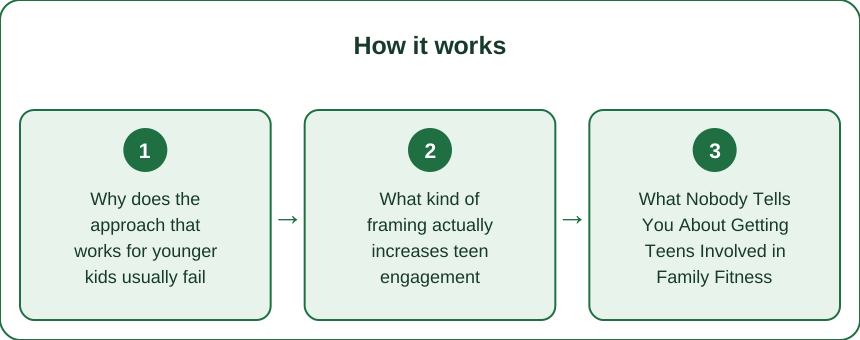
Why does the approach that works for younger kids usually fail with teenagers?
Younger children generally respond well to parent-led structure and enthusiasm alone, but teenagers are developmentally focused on autonomy and are more likely to resist anything that feels imposed rather than chosen, even if the activity itself would otherwise appeal to them.
This is why simply extending a family workout routine that worked for younger kids often backfires with a teen — the resistance is frequently more about the lack of choice and framing than the activity itself.
What kind of framing actually increases teen engagement instead of triggering resistance?
Framing an activity around something the teen already values — a specific sport interest, social time, or even competitive elements like a friendly family challenge — tends to land far better than framing centered on health, exercise, or family bonding explicitly, since those explicit framings can feel like a lecture in disguise to a teenager.
Offering a genuine choice between a couple of options (rather than one prescribed activity) also meaningfully increases willingness to participate, since it preserves the autonomy that matters developmentally at this age.

What Nobody Tells You About Getting Teens Involved in Family Fitness
Nobody tells you that a teen showing up reluctantly and grumbling can still be a genuine win — engagement often builds gradually rather than starting enthusiastic.
Nobody tells you that involving a teen’s friend in the activity dramatically increases the odds of buy-in, since peer presence matters more at this age than family presence alone.
Nobody tells you that backing off when a teen says no to a specific week, rather than pushing, often preserves more long-term willingness than insisting every single time.
Is there a specific type of activity that tends to work better than others for teen buy-in?
Activities with a social or competitive element — a family bike ride to somewhere specific, a friendly obstacle course challenge, a sport the teen already plays casually with friends — tend to outperform a generic structured family workout session, since they tap into the social and autonomy needs that matter most developmentally at this age.
Something entirely new and unfamiliar to the teen tends to have a higher resistance barrier than something adjacent to an activity they already have some existing interest or skill in.
FAQ: Teen Family Fitness Buy-In Questions, Answered
Should parents insist on participation even when a teen strongly resists?
Most family therapists and pediatric health guidance suggest offering rather than insisting, since forced participation tends to build longer-term resistance rather than genuine engagement.
Does it help to let the teen choose the activity entirely on their own?
Yes, generally — even choosing between two parent-suggested options provides a meaningful sense of autonomy compared to no choice at all.
Is occasional participation (not every week) still worthwhile for a reluctant teen?
Yes — inconsistent but genuine participation tends to build more positive association over time than either forced weekly participation or no attempt at all.
TL;DR:
- Teens respond to autonomy and choice far more than the structure that works for younger kids
- Framing around social or competitive interest tends to beat explicit health or bonding framing
- Including a teen’s friend in the activity meaningfully increases genuine engagement
- Backing off after resistance, rather than insisting, tends to preserve willingness longer term
The goal isn’t forcing enthusiasm — it’s removing the specific barriers that make a teen say no in the first place.
Keep Reading
This article is for general informational and styling purposes only. Fit, sizing, and product availability may vary.