Family Fitness When One Kid Has Practice Every Single Night
Quick Answer: When one child’s practice schedule owns the evenings, the rest of the family gets less active, not more. The fix is to convert waiting time into movement time - a 25 minute walk around the field during practice, a sibling activity that runs parallel, and one weekend block that belongs to everyone else. Trying to schedule a separate family workout around a sports calendar almost never survives past week two.
The household with the most athletic child is frequently the least active household overall, and it happens quietly.

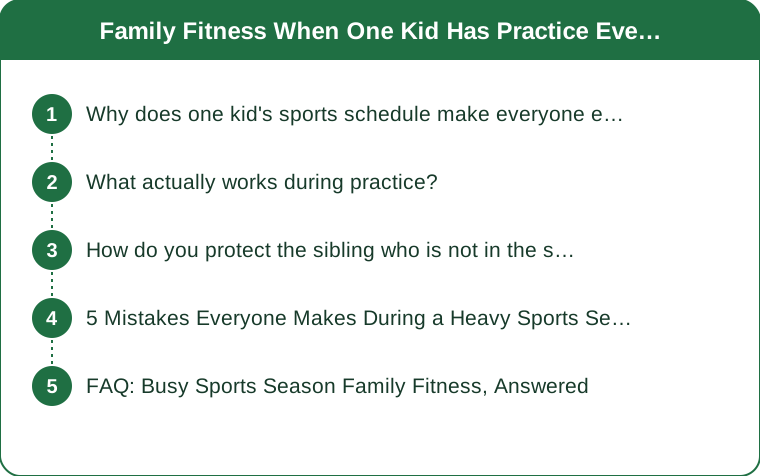
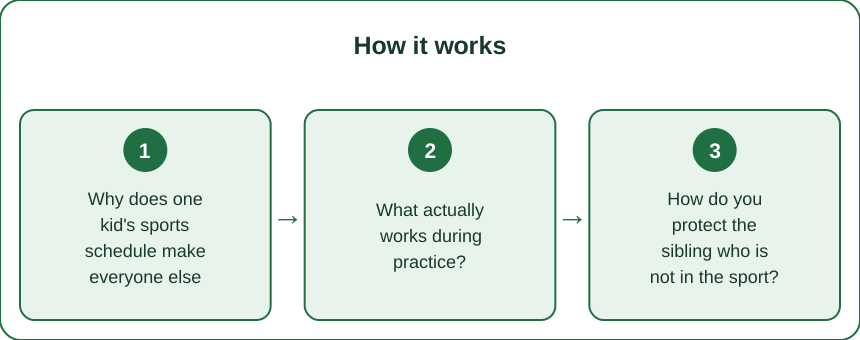
Why does one kid’s sports schedule make everyone else sedentary?
Because it converts the family’s most available movement window into transportation and waiting.
The evening between 5 and 8pm is where most family activity lived. A practice schedule replaces it with a drive, a wait, a drive back and a late dinner. Nobody decided to be less active; the slot simply got occupied.
The sibling effect is the sharper problem. The child who is not in the sport loses their outdoor time to a car and a folding chair, several times a week. Over a season that is a substantial amount of movement that quietly disappears.
And the parent driving is often the most affected. Two hours of sitting in a car and on a sideline, three to five nights a week, replaces whatever walking or workout used to happen.
The reframe that works: stop trying to find a new time slot. The time is already there - it is currently being spent sitting near a field.
What actually works during practice?
Walk the perimeter. A standard field loop is roughly a quarter to a half mile. Six loops over a 75-minute practice is a real walk, and you are still present.
Bring the sibling’s activity, not the sibling’s screen. A ball, a scooter, a jump rope, a frisbee. The default in a parking lot is a tablet, and the default is what happens unless something else is in the car.
Find the parallel option. Many facilities have a walking track, an adjacent park or a quiet field. Some have a gym. Ask - parents routinely discover in month three that a track was available in month one.
Use two practices a week, not all of them. A rule of every practice is a rule that breaks. Two is sustainable and produces most of the benefit.
Bring shoes you can actually walk in. Trivial and decisive. The single most common reason a sideline walk does not happen is footwear chosen for a different part of the day.

How do you protect the sibling who is not in the sport?
This is where the real cost lands, and it is worth being deliberate about.
Give them one fixed weekly block that is theirs. Same day, same time, non-negotiable, and not scheduled around the sport. What it is matters far less than that it does not move.
Let them choose the activity, genuinely. A sibling who feels their thing exists to balance somebody else’s thing will opt out of it. A sibling who picked rock climbing because they wanted to climb rocks will not.
Make the sideline time theirs too. Scooter, bike, ball, a friend invited along. Practice becomes their outdoor hour rather than their waiting hour.
Watch the comparison language. Kids who spend three nights a week watching a sibling be coached and praised often draw conclusions about their own athleticism. Comment on their effort in their own activity, and avoid framing it as at least you get exercise too.
Weekends carry the load. One family activity a week - a hike, a bike ride, a swim - does more for the non-athlete sibling than any weeknight arrangement.
5 Mistakes Everyone Makes During a Heavy Sports Season
1. Scheduling a separate family workout. Adding a commitment to a calendar that is already the problem. It will be cancelled by the second week and then it feels like a failure rather than a bad plan.
2. Treating the sideline as dead time. It is 75 minutes, three to five times a week. It is the single largest block of unused time in the family week.
3. Letting the athlete’s nutrition dictate everyone’s dinner. Late, rushed, drive-through-adjacent dinners for the whole household so one person can eat after practice. Feed the athlete separately when needed and protect a reasonable family meal.
4. Assuming the athlete is fine. A child in one sport year-round is at elevated risk for overuse injury and burnout, and a single-sport schedule with no off-season is a known risk pattern rather than a sign of dedication.
5. Waiting for the season to end. Seasons overlap. The next one starts before the last one finishes, and a plan that begins after this season begins never - the fourth item here is the one families most often regret not acting on earlier.
FAQ: Busy Sports Season Family Fitness, Answered
How much movement should the non-athlete sibling be getting?
General guidance for children and adolescents is around 60 minutes of moderate to vigorous activity daily. The realistic goal during a heavy season is one protected activity block per week plus active sideline time, which gets most kids much closer than a car and a folding chair does.
My teenager refuses to walk with me at practice. Now what?
Do not make it a joint activity. Walk your loops, let them bring a friend or a ball, and drop the requirement that it happen together. Autonomy is doing most of the work at that age.
Is it bad for one child to be in the same sport all year?
It raises the risk of overuse injury and burnout, and most guidance suggests a period away from the sport each year plus at least one full rest day weekly. It is a conversation worth having with the coach rather than a reason to panic.
This is general information, not medical advice.
TL;DR:
- A heavy sports schedule does not add family activity, it replaces it - with driving and waiting.
- The fix is converting sideline time rather than finding a new time slot, which never survives.
- Walk the perimeter on two practices a week and put the sibling’s equipment in the car, not a tablet.
- Give the non-athlete sibling one fixed weekly block they chose, and let the weekend carry the family activity.
Nothing here requires more time, because more time does not exist during a season. It requires using the 75 minutes you are already spending at the field for something other than sitting in a chair.
Keep Reading
This article is for general informational and styling purposes only. Fit, sizing, and product availability may vary.