What to Do When Your Kid Wants to Quit the Family Workout Halfway Through
Quick Answer: When a kid wants to quit mid-workout, switching to a shorter, game-like activity rather than pushing through the planned session usually salvages the moment better than insisting — kids’ attention spans for structured activity are genuinely shorter than adults’, so the ‘quitting’ is often a normal signal, not defiance.
It happens to almost every family that tries regular movement time together: the plan was a 20-minute family workout, and five minutes in, someone’s done. That’s not a failure of the plan.

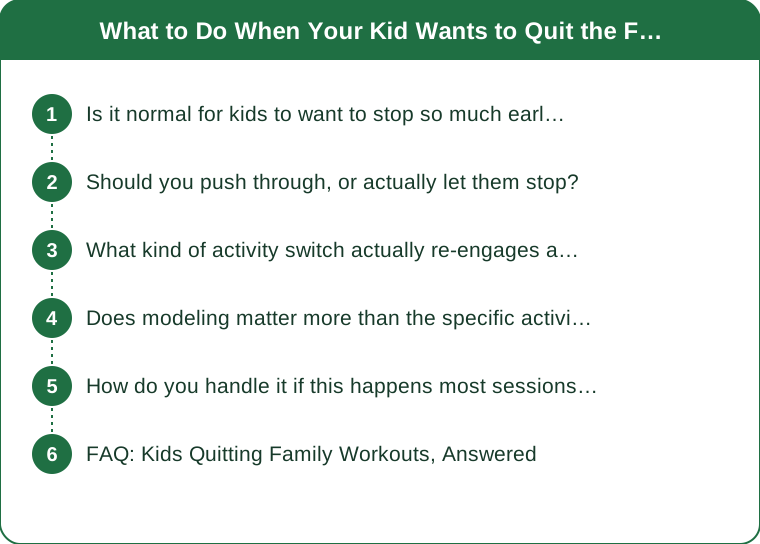
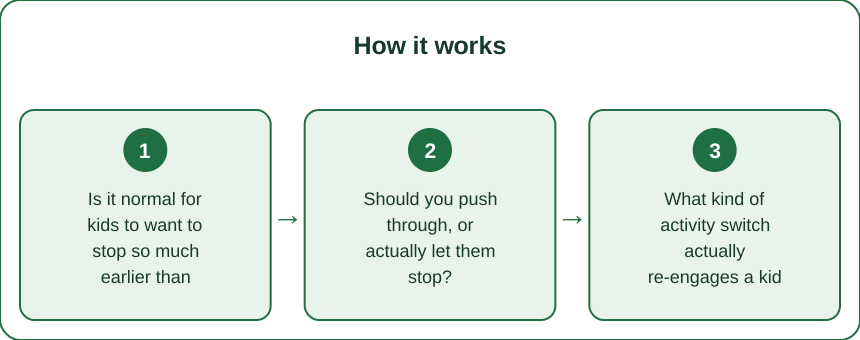
Is it normal for kids to want to stop so much earlier than planned?
Yes — children’s sustained attention for a single structured activity is genuinely shorter than adults’, and this is a normal developmental pattern, not a discipline issue. A workout planned around adult attention spans is often mismatched to what a young child can realistically sustain, regardless of how fun the activity seems at the start.
Should you push through, or actually let them stop?
Generally, switching to something shorter and more game-like works better than insisting they finish the original plan — forcing continuation through a genuine attention lapse tends to build negative associations with family exercise time, which works against the actual long-term goal of kids enjoying movement.
What kind of activity switch actually re-engages a kid who’s checked out?
Adding a game element — a mini race, a silly challenge, or letting them pick the next activity — often re-engages kids faster than continuing the original structured exercise. The goal at that point shifts from ‘complete the planned workout’ to ‘keep movement fun,’ which are different goals with different tactics.

Does modeling matter more than the specific activity chosen?
Quite a bit — kids consistently report that seeing parents enjoy movement themselves matters more to their own long-term relationship with exercise than the specific activities done together. A parent who visibly has fun during family fitness time, even a shortened or changed session, models something more durable than a perfectly completed workout plan.
How do you handle it if this happens most sessions, not just occasionally?
If quitting mid-session is the regular pattern rather than occasional, it’s usually worth shortening the planned activity length from the start rather than repeatedly hitting the same wall — starting with a genuinely shorter, more flexible plan tends to produce more consistent family movement time than repeatedly cutting a too-long plan short.
FAQ: Kids Quitting Family Workouts, Answered
What’s a realistic length for a family workout with young kids?
Many families find 10-15 minutes of actual structured activity, with flexibility to extend if kids are engaged, works better than a fixed longer target.
Does this pattern mean a kid dislikes exercise generally?
Not necessarily — it’s often about attention span for that specific activity structure, not a broader dislike of movement.
Should older kids and younger kids do the same family workout?
Mixed-age family workouts often work better with flexible, game-based structures that let each child engage at their own level rather than one uniform routine.
TL;DR:
- Kids’ attention spans for structured activity are genuinely shorter than adults’
- Switching to a shorter, game-like activity works better than pushing through
- Adding a game element often re-engages a checked-out kid quickly
- Parents visibly enjoying movement matters more long-term than session completion
- If quitting happens most sessions, shorten the plan from the start
A family workout that ends early with everyone still smiling did its job better than one that ran the full planned length through resistance.
Keep Reading
This article is for general informational and styling purposes only. Fit, sizing, and product availability may vary.