Family Workouts When a Grandparent Is Part of the Household
Quick Answer: Stop looking for one activity everyone can do together at the same intensity - it does not exist across a 60-year age range. Instead use the same time, the same place, different jobs. A walk where one person pushes a pram, one does intervals ahead, and one sets the pace works for everyone. Build it around balance and strength for the grandparent (the two things that most affect independence) and let the intensity for everyone else be their own problem.
A household with three generations in it has something most families do not: an adult with a flexible daytime schedule, a genuine motivation to stay mobile, and often more patience with a slow activity than the parents have. That is a resource, and most families accidentally waste it by treating grandparents as spectators.
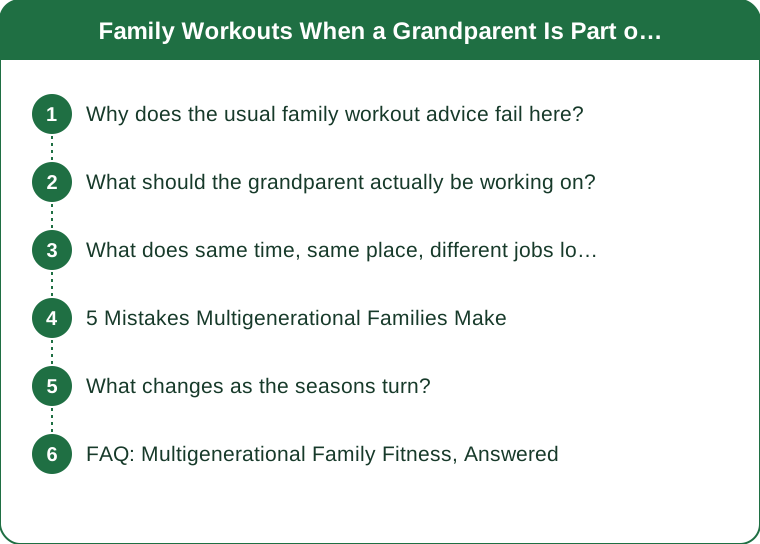
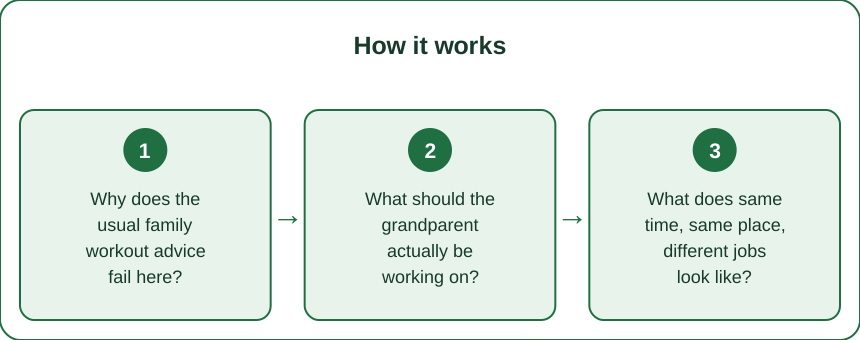
Why does the usual family workout advice fail here?
Because it is built on the assumption of a narrow ability range, and a multigenerational household has a wide one.
Standard family fitness content assumes parents in their 30s or 40s and children under 15. The activities are chosen for the middle of that range - a bike ride, a game in the garden, a hike. Add someone in their 70s and the advice quietly stops working, because those activities have a floor that is too high or a surface that is too risky.
The second failure is more subtle. When an activity is chosen that a grandparent cannot fully join, they usually become the watcher, the bag holder, or the person who stays home. That role gets established quickly and it is very hard to reverse.
And the third: the goals are genuinely different. A 12-year-old needs skill and play. A 40-year-old needs cardiovascular fitness and strength. A 72-year-old needs balance, leg strength, and grip - the three things that most directly predict whether they keep living independently. Pretending these are the same goal serves nobody.
What should the grandparent actually be working on?
Three things, and they are more specific than general activity.
Balance. The strongest single lever on fall risk, and falls are the thing that most often ends independence. Balance responds well to training at any age, and it needs frequency over duration - a minute a day beats twenty minutes a week. Standing on one leg while the kettle boils genuinely counts.
Leg strength, specifically sit-to-stand. The ability to get out of a chair without hands is one of the most functional measures there is. Ten sit-to-stands from a dining chair, done twice a day, is a real training stimulus for most people over 65.
Grip strength. Correlated with a striking range of health outcomes and easy to train incidentally - carrying shopping in two hands rather than making two trips, opening jars, holding onto a resistance band.
The useful part for a family is that all three fit into normal household life rather than requiring a session. Which means they survive the weeks when nothing else does.
This is general information, not medical advice - anyone with a heart condition, a recent fall, or joint replacements should get specific clearance first.
What does same time, same place, different jobs look like?
Four formats that genuinely work across three generations.
The layered walk. Everyone leaves together. The grandparent sets the base pace on a flat, even surface. A parent runs ahead to a landmark and back, repeatedly. Kids scooter or run loops. Everybody gets what they need, nobody waits, and the group stays together in space if not in speed.
The garden circuit. Four stations, each person doing their own version. Sit-to-stands from a chair for the grandparent, squats for a parent, jump squats for a teenager. Same station, same timer, different move. This one is unexpectedly popular with kids because the shared timer makes it feel like a group activity.
Pool time. The best single option if you have access. Water removes the fall risk and the joint load entirely, and it is one of the few environments where a 70-year-old and a 7-year-old can genuinely do the same thing.
The task walk. Walking to a destination with a purpose - the shop, the post box, the park. Purpose beats exercise framing for almost every age group, and it is particularly effective for a grandparent who does not think of themselves as someone who exercises.

5 Mistakes Multigenerational Families Make
1. Treating the grandparent as the constraint. The framing matters more than the logistics. An activity described as being for the grandparent gets quiet resistance from everyone including the grandparent. The layered walk works because nobody is the constraint.
2. Picking uneven ground. Trail walks, beaches, and grass are where falls happen. The same walk on a flat path is 90% of the benefit at a fraction of the risk. Save the trails for the days when a parent can walk alongside.
3. Going too long. Two 15-minute outings beat one 45-minute one at both ends of the age range, for different reasons. Older adults fatigue and their balance degrades as they tire; children lose interest.
4. Skipping strength entirely. Walking is the default multigenerational activity and it does almost nothing for the leg strength and grip that matter most for staying independent. Add the sit-to-stands. They take 90 seconds.
5. Not asking what they want to do. The most common reason a grandparent does not join is that nobody asked, or the first thing offered was clearly unsuitable and nothing was offered after that. Ask about walking, swimming, dancing, and gardening specifically - the answer is often surprising.
What changes as the seasons turn?
Autumn is the point where multigenerational movement usually falls apart, and it is worth planning for now rather than in November.
Daylight is the main constraint. The after-school and after-work window closes fast from September onward, and it is the window most families use. Shifting the walk to before school or at lunch while the weather still allows it builds a habit that survives the dark, particularly if the grandparent is the one who is home during the day.
Cold affects older joints more, and earlier. Stiffness in the morning is a real barrier and the fix is simple: move the outing to mid-morning or afternoon rather than first thing, and add five extra minutes of warm-up walking at the start.
Wet leaves are the specific hazard. More slippery than rain and much more slippery than they look. This is the seasonal reason to prefer pavements over park paths from October.
Indoor fallback needs to exist before you need it. A garden circuit that moves into a hallway, a stair routine, or a chair-based circuit in the living room. Families that do not decide this in advance simply stop in the first bad week and often do not restart until spring.
FAQ: Multigenerational Family Fitness, Answered
What if the grandparent has no interest at all?
Start with something that is not framed as exercise - walking to collect a grandchild, a task walk, gardening. Purpose-based movement has much lower resistance than exercise-based movement, and it delivers most of the same benefit.
How do we handle very different attention spans?
Use the shared timer rather than the shared activity. Everyone works for the same three minutes doing their own thing, then everyone rests. It holds a 7-year-old and a 72-year-old together better than any single activity.
Is it safe for an older adult to do strength work at home?
Generally yes for bodyweight movements like sit-to-stands and wall push-ups, and the evidence for strength training in older adults is strong. Get individual clearance first if there is heart disease, a recent fall, dizziness, or a joint replacement.
TL;DR:
- Use same time, same place, different jobs rather than hunting for one activity everyone can do.
- The grandparent’s goals are balance, sit-to-stand strength, and grip - not general activity.
- The layered walk is the single most reliable format, and the garden circuit with a shared timer is the best indoor version.
- Choose flat, even surfaces, keep outings short, and set up the winter fallback before the clocks change.
A three-generation household is the easiest kind of family to keep moving, once you stop trying to make everyone do the same thing. The shared timer does more work than any activity you could pick.
Keep Reading
This article is for general informational and styling purposes only. Fit, sizing, and product availability may vary.