How Family Workouts Survive the Week School Starts
Quick Answer: Summer family routines collapse in September because they were built on unstructured time that no longer exists, not because anyone lost motivation. The fix is to rebuild around the two windows that survive a school schedule - the 20 minutes right after school and the weekend morning - and to cut the session length roughly in half rather than trying to protect the summer version.
The families that keep going are the ones who plan the smaller version before the term starts, not the ones who try hardest to keep the big one.

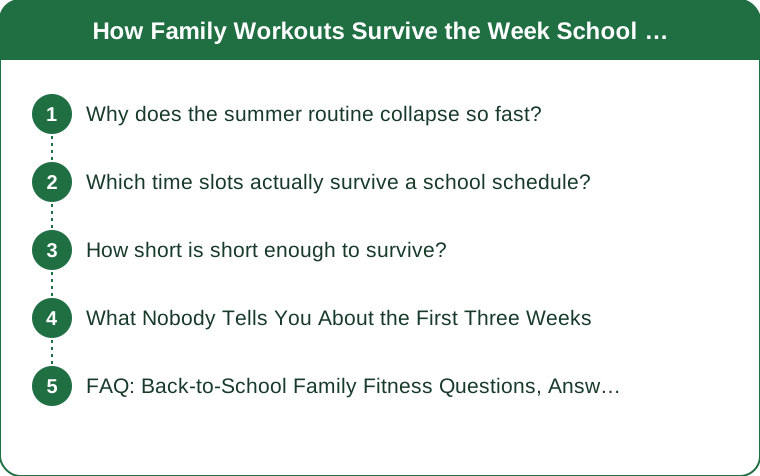
Why does the summer routine collapse so fast?
Because it was running on a resource that disappears overnight.
A summer family workout typically happens in a large block of unallocated time - late morning, mid-afternoon, whenever. It does not compete with anything. Nobody has to be moved for it to happen.
A school-year afternoon is the opposite: it is fully allocated and highly sequenced. Pickup at a fixed time, homework, an activity two days a week, dinner, bedtime that actually matters because of a fixed wake time. There is no unallocated block left to put anything into.
So what happens is not that the family stops wanting to exercise. It is that the activity has nowhere to go, and an activity with nowhere to go stops happening within about a week.
There is a second, quieter factor: decision fatigue at 4pm. In summer, deciding to go outside is a low-stakes choice made by rested people. In the first weeks of term, everyone is tired in a way they were not in August - new schedules, earlier alarms, more stimulation - and a plan requiring a decision at 4pm will lose to the sofa most days.
The useful reframing: this is a logistics failure, not a discipline failure. Families who understand it as the latter respond by trying harder, which does not create time. Families who understand it as the former respond by redesigning the slot, which does.
Which time slots actually survive a school schedule?
Two of them reliably, and it is worth knowing which before term starts.
The immediate after-school window - roughly 20 to 30 minutes. Right after pickup or right after the bus, before bags are unpacked and before anyone sits down. This works because it exploits an existing transition rather than requiring a new one, and because children genuinely need to move after a day of sitting. It fails if you let it drift by even fifteen minutes; once someone has sat down, the window has closed.
The weekend morning. Saturday or Sunday before around 10am, before the day fills with sport, birthday parties, and errands. This is where a longer session can live - a walk, a bike ride, a swim.
Two slots that people expect to work and usually do not:
- After dinner. Sounds sensible, competes with homework, bedtime routines, and everyone’s remaining energy. Works for some families with older children, fails for most with young ones.
- Before school. Almost never survives contact with a real school morning, unless the family is already up early for another reason. The morning is the tightest-scheduled part of the day.
The realistic target for the school year is therefore something like three short weekday sessions plus one longer weekend one - not the five substantial sessions that summer allowed. Naming that reduction out loud, in advance, is what stops it feeling like failure when it happens.

How short is short enough to survive?
Shorter than feels worthwhile, which is the point.
The common error is trying to preserve the 45-minute summer session in a 25-minute slot, running late, and abandoning it after two attempts. A 15-minute session that happens beats a 45-minute one that does not, and it is not close.
What 15 to 20 minutes can genuinely contain:
- A brisk walk around the block - roughly a mile for most families, and enough to shift everyone’s mood.
- A short circuit in the garden or living room - four movements, 40 seconds each, three rounds. Kids handle this format well because it has a visible end.
- A scooter or bike loop.
- Ten minutes of a game - tag, a ball game, anything with a scoreboard.
The activity guidelines for children are 60 minutes daily, which no family workout is going to deliver on its own. That is fine. The family session is not meant to be the whole 60 minutes - school break times, walking, and play do most of it. The family session’s job is to be the reliable anchor and the part that happens with a parent.
One detail that matters more than the content: keep the same shape every time. A predictable structure - same route, same four movements - removes the daily negotiation, which is the thing that actually kills these routines. Novelty is what you add on the weekend when there is time to absorb the friction of explaining something new.
What Nobody Tells You About the First Three Weeks
Everyone is more tired than they will admit, and planning for that is the difference between a routine that survives and one that does not.
The return to school is a genuine circadian and cognitive load event. Children shift their wake time by often an hour or more, spend all day in a highly stimulating environment after weeks of not doing so, and are managing new social configurations. Adults are absorbing a schedule change at the same time.
Research on sleep and schedule transitions is consistent that adaptation to a shifted wake time takes roughly one to two weeks, and irritability and fatigue during that window are normal rather than a sign anything is wrong.
Which means the first three weeks of term are the worst possible time to introduce anything new or demanding, and also, unfortunately, exactly when most families try to establish the new routine.
A better sequence:
- Weeks 1 to 2: protect only the weekend session. One thing. Let the weekdays be whatever they are.
- Week 3: add one weekday slot, the after-school one, at 15 minutes.
- Weeks 4 to 6: add the second and third weekday slots as they prove sustainable.
This feels slow. It produces a routine that is still running in November, which the ambitious version reliably does not.
One more thing worth naming: children who seem resistant in the first weeks are usually tired rather than uninterested. The same child who refuses a walk in week one will often ask for it in week five. Reading week-one resistance as a permanent verdict is a common and costly mistake.
FAQ: Back-to-School Family Fitness Questions, Answered
What if the after-school window is taken by an organized sport?
Then that is the session, and it counts. The goal is movement, not a specific family activity. Use the days without practice for the family slot, and use practice days for a short walk while you wait if that is practical.
How do I handle a wide age gap between children?
Give the older child a role rather than a modified version - leading a warm-up, timing rounds, choosing the route. Age-gap problems are usually engagement problems disguised as ability problems. Walking and cycling handle mixed ages better than circuits do.
What if I am the one who is too tired?
Common and worth taking seriously rather than pushing through indefinitely. Cut to the weekend session only for a few weeks. A parent running on empty in September is not going to hold a five-day routine together in October, and the routine outlasting the term matters more than this week’s consistency.
Is it worth doing at all if it is only 15 minutes?
Yes, for two reasons beyond the physical. It creates a reliable daily point of contact with your children at a time of year when everyone is busy and distracted, and it establishes movement as a normal part of the day rather than an occasional event. Both of those compound in a way that the 15 minutes of exercise alone does not.
TL;DR:
- Summer routines collapse because school allocates every hour, not because anyone lost motivation - it is a logistics problem.
- Two slots survive: the 20 minutes immediately after school, and the weekend morning before 10am.
- Cut the session roughly in half; a 15-minute session that happens beats a 45-minute one that does not.
- Keep the same shape every time - predictability removes the daily negotiation that kills these routines.
- Protect only the weekend session for the first two weeks of term, then add weekday slots one at a time.
Week-one resistance from a tired child is not a verdict. Ask again in week five.
Keep Reading
This article is for general informational and styling purposes only. Fit, sizing, and product availability may vary.