Why Family Workout Plans Fall Apart After the First Week (and the Fix That Actually Sticks)
Quick Answer: Family workouts collapse after week one mostly because the first session is planned as a special event rather than a repeatable routine — fixing it means shrinking the commitment to something so short and low-effort that skipping it feels harder than doing it.
Everyone shows up excited for the first family workout. By the second week, someone has homework, someone’s tired, and the whole thing quietly disappears — and it’s rarely about motivation.

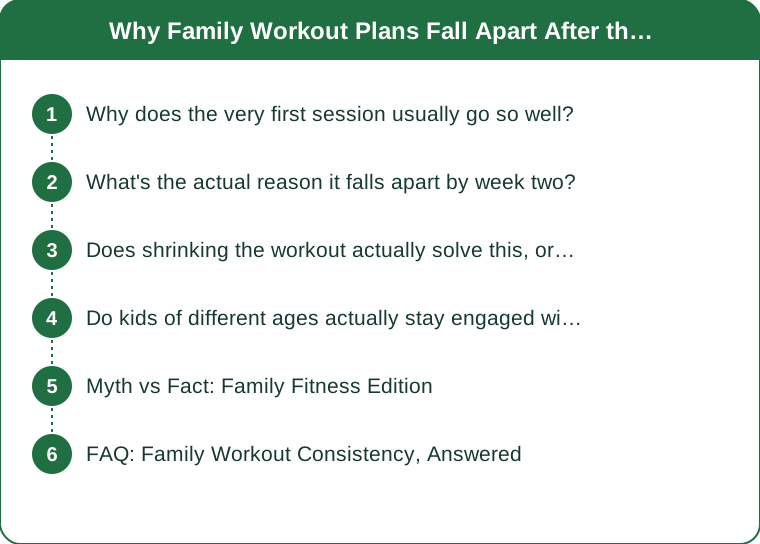
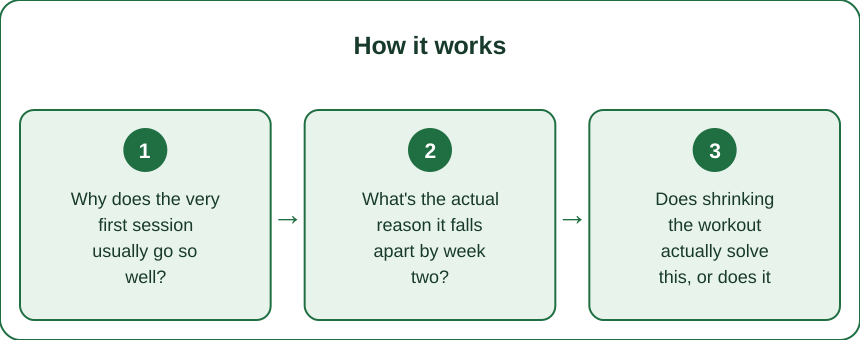
Why does the very first session usually go so well?
The first attempt is almost always overplanned and novel — a full 45-minute circuit, new equipment, everyone’s calendar cleared for it. Novelty carries the first session on its own, which is exactly why it doesn’t predict whether the habit survives once the newness wears off.
What’s the actual reason it falls apart by week two?
The plan was sized for a special occasion, not a Tuesday. A 45-minute commitment competes with homework, dinner, and everyone’s mood, so it gets bumped once, then twice, and by week two it’s simply not on anyone’s radar anymore — the ambition of session one becomes the reason session four never happens.
Does shrinking the workout actually solve this, or does it just delay the same problem?
It solves it, because the mechanism is different: a 10-minute family movement block is small enough that skipping it takes more mental negotiation than just doing it. Consistency research on habit formation consistently shows that frequency matters more than duration for building a routine that survives busy weeks.

Do kids of different ages actually stay engaged with the same short routine?
Yes, more than a longer one — a shorter block means younger kids don’t hit their attention limit before it’s over, and older kids don’t have time to get bored or start negotiating an exit. Matching the routine length to the shortest attention span in the room, not the longest, is what keeps everyone actually participating.
Myth vs Fact: Family Fitness Edition
Myth: A family workout needs real structure — warmup, main set, cooldown — to count. Fact: for a household routine, five minutes of genuine movement done four days a week produces more real benefit than a fully structured 40-minute session done once and then abandoned.
Myth: If the kids resist, the routine isn’t working. Fact: some resistance in the first two weeks is normal and doesn’t predict long-term buy-in — what predicts it is whether the parent keeps showing up regardless of the day’s enthusiasm level.
Myth: Everyone has to do the exact same movements. Fact: parallel play works fine — a parent doing squats while a toddler does their own version nearby still counts as a shared routine, and forcing identical movements across ages is often what causes the friction in the first place.
FAQ: Family Workout Consistency, Answered
How short can a family workout actually be and still count?
Five minutes of genuine, focused movement is enough to build the routine — the goal in the first month is frequency, not duration, and duration can grow naturally once the habit itself is established.
What time of day works best for keeping a family routine consistent?
Attaching it to an already-fixed daily anchor (right after breakfast, right before bath time) works better than picking an open time slot, since a fixed anchor removes the daily decision of when to fit it in.
Is it normal for one child to want to keep going longer while another wants to stop?
Yes, very common — letting the routine officially end at the agreed short time, with an optional extension for whoever wants more, avoids turning the whole thing into a negotiation every single day.
TL;DR:
- The first family workout succeeds on novelty, not on the plan being sustainable
- Oversized time commitments are the real reason the routine disappears by week two
- A 5-10 minute daily block beats a long weekly session for actually sticking
- Matching the length to the shortest attention span in the room keeps everyone engaged
The fix was never more enthusiasm — it was a smaller, repeatable version of the same idea.
Keep Reading
This article is for general informational and styling purposes only. Fit, sizing, and product availability may vary.