Why the After-School Hour Is the Only Family Workout Slot That Survives
Quick Answer: The hour right after school works because it sits in a natural gap between two fixed points - the pickup and the start of the evening routine - and because children arrive already dysregulated from a day of sitting, which makes movement genuinely welcome rather than an imposition. Morning slots fail on sleep pressure and time scarcity, and post-dinner slots fail because homework and screens have already claimed the space. Twenty minutes in that window beats an ambitious hour anywhere else.
You have tried this before. There was a weekend plan in January and a before-school plan in April, and both lasted about eleven days. It is worth knowing that neither failed because of your family - they failed because of when they were scheduled.

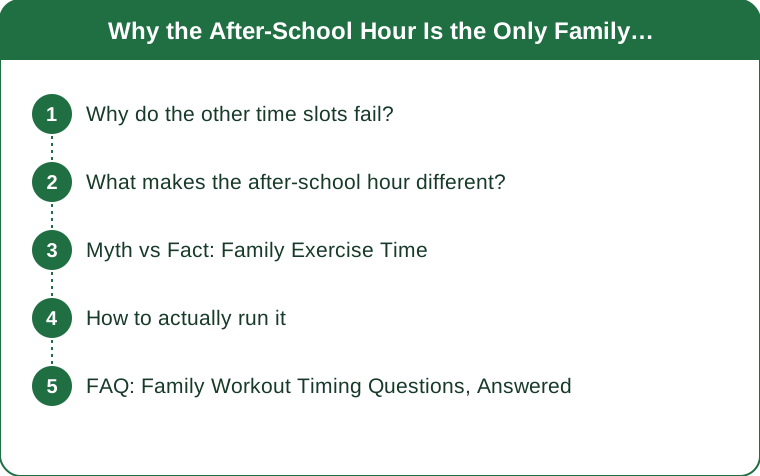
Why do the other time slots fail?
Each one has a specific structural problem, and none of them are about motivation.
Before school fails on time scarcity and sleep. Mornings with children are the most compressed hour of the day and the least elastic - there is a hard deadline and no slack. Adding anything to it means subtracting from sleep, and children and teenagers are already sleeping less than they need. Any plan that requires waking earlier is borrowing from the one input that most affects mood, behaviour, and school performance.
Post-dinner fails on competition. By 7pm, homework exists, screens have been negotiated over, and the evening has a momentum that is very hard to interrupt. Anything scheduled here is competing with activities that have already started, and the thing that has already started usually wins.
Weekends fail on irregularity. They look like the obvious answer because the time exists. But weekend structure changes every week - a birthday party, a match, a visit, a lie-in - so the habit never gets the repetition it needs to become automatic. A slot that occurs five times a week builds a habit roughly five times faster than one that occurs twice, and the weekend slot does not even reliably occur twice.
And “whenever we can” fails because it is not a plan. Without a fixed cue it relies on someone raising it, which means someone has to be the person who suggests exercise, which is a role nobody enjoys occupying repeatedly.
The common factor: every failed slot either competes with something entrenched or lacks a reliable trigger. The after-school window has neither problem.
What makes the after-school hour different?
Four things, and they compound.
It sits between two fixed points. School ends at a set time and the evening routine starts at a set time. That creates a genuine gap with defined edges, and gaps with edges are where habits survive. Nothing else is trying to occupy it - the homework has not started, dinner is not ready, and screens have not been switched on yet.
Children arrive needing it. After six hours of sitting and self-regulating, most children are physically restless and emotionally frayed. That combination is why the hour after pickup is a well-known behavioural flashpoint in a lot of households. Movement is the most effective available intervention for exactly that state - it is not an additional demand, it is a release valve.
The transition is already happening. Everyone is changing clothes, dropping bags, moving between places. Habits attach far more easily to moments of transition than to moments of settled activity, because there is no momentum to interrupt.
The light is right, for now. Mid-August still has plenty of light at 4pm and will do through most of the autumn. This slot gets outdoors more reliably than the evening one, and it does so precisely during the season when outdoor time starts shrinking.
And it has a natural end. It stops when dinner needs making, which caps the ambition at something sustainable and removes the open-ended quality that makes people avoid starting.

Myth vs Fact: Family Exercise Time
Myth: Children need a full hour of structured activity. Fact: Guidelines suggest around 60 minutes of moderate-to-vigorous activity daily for children, but that is a total across the whole day including break times, walking, and free play - not a single block you have to deliver. Twenty focused minutes after school is a meaningful contribution, not a shortfall.
Myth: It has to be exercise to count. Fact: For children under about twelve, unstructured active play produces equal or better outcomes for fitness and motor development than structured exercise, and vastly better adherence. A game of tag is not a compromise version of a workout. For this age group it is the better option.
Myth: Everyone has to do the same thing. Fact: Parallel activity works fine - one person running intervals while another rides a bike alongside, or a teenager doing their own thing in the same space. Being together matters more than doing the same movement, and forcing a teenager into a shared activity is the fastest way to lose them.
Myth: You need equipment or a destination. Fact: The highest-adherence family activities are the ones requiring zero setup - a walk, a ball in the garden, a scooter to the end of the road. Anything that requires loading a car has a failure point built into it.
Myth: If you miss a few days the habit is broken. Fact: Habits survive gaps considerably better than people assume. What breaks them is abandoning the slot entirely after a bad week. Return to the same time on the next available day and the thread holds.
How to actually run it
Set the trigger, not the activity. The rule is “bags down, shoes on, outside” - it fires every school day regardless of what happens next. Deciding the activity in advance creates a negotiation; deciding the trigger removes one.
Twenty minutes, capped. Set it explicitly and stop at twenty even if it is going well, for the first month. Ending while everyone still wants more is the oldest trick in habit formation and it works on adults too.
Have three defaults, chosen once. Not a plan each day - three options you rotate:
- Outdoor free option: ball game, tag, scooters, the park.
- Walk option: a fixed loop, same route, for low-energy days.
- Indoor option for rain: an obstacle course, a movement game, a follow-along video.
Let the children pick from the three. Autonomy is one of the strongest predictors of whether children keep participating in physical activity. Choosing between three parent-approved options gives real agency with no risk.
Snack first, if needed. Some children cannot do anything at 3:30 until they have eaten. Five minutes with something quick, then out. Fighting this is not worth it.
Teenagers get a modified deal. A shared activity is often a hard sell. What works better is same-time, same-place, different-activity - they run, you walk, both outside for the same twenty minutes. Presence without prescription.
Handle the September ramp deliberately. The first fortnight back is when children are most tired and most resistant, and it is also when the habit gets set. Reduce to ten minutes and a walk for those two weeks rather than skipping - the slot surviving matters far more than the content of it.
And the one thing that predicts success more than anything else: the adult goes too. Family activity where the adult participates has dramatically better adherence than family activity the adult supervises.
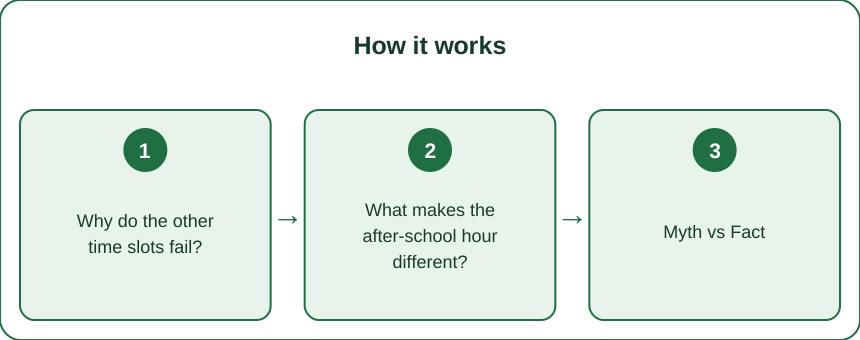
FAQ: Family Workout Timing Questions, Answered
What is the best time for a family workout?
The hour immediately after school, because it sits in a genuine gap between the pickup and the evening routine, nothing else has claimed it yet, and children arrive physically restless after a day of sitting. Twenty minutes there outperforms an ambitious hour scheduled anywhere else.
How long should a family workout be?
Twenty minutes is the sweet spot for building the habit, and it is worth capping it there deliberately for the first month even on days it is going well. Children need around 60 minutes of activity daily but that is a total across the whole day, not one block you have to provide.
How do you get teenagers to join in?
Same time and same place, different activity. Requiring a shared activity is usually where teenagers disengage. Being outside at the same time, doing their own thing, preserves the routine and the togetherness without the negotiation.
What if we miss several days?
Return to the same slot on the next school day. Habits tolerate gaps far better than people expect; what actually ends them is abandoning the time slot rather than missing sessions. During the tired first fortnight of a new term, shorten it to ten minutes rather than skipping it.
TL;DR:
- The after-school hour has defined edges and no competition - that is the whole advantage.
- Children arrive restless from sitting all day, so movement is a release rather than a demand.
- Fix the trigger (“bags down, shoes on, outside”), not the activity.
- Three rotating defaults, child picks; cap at twenty minutes for the first month.
- The adult participating, rather than supervising, is the strongest predictor of it lasting.
The January weekend plan did not fail because your family lacks discipline. It failed because weekends do not repeat, and 3:30 on a Tuesday does.
Keep Reading
This article is for general informational and styling purposes only. Fit, sizing, and product availability may vary.